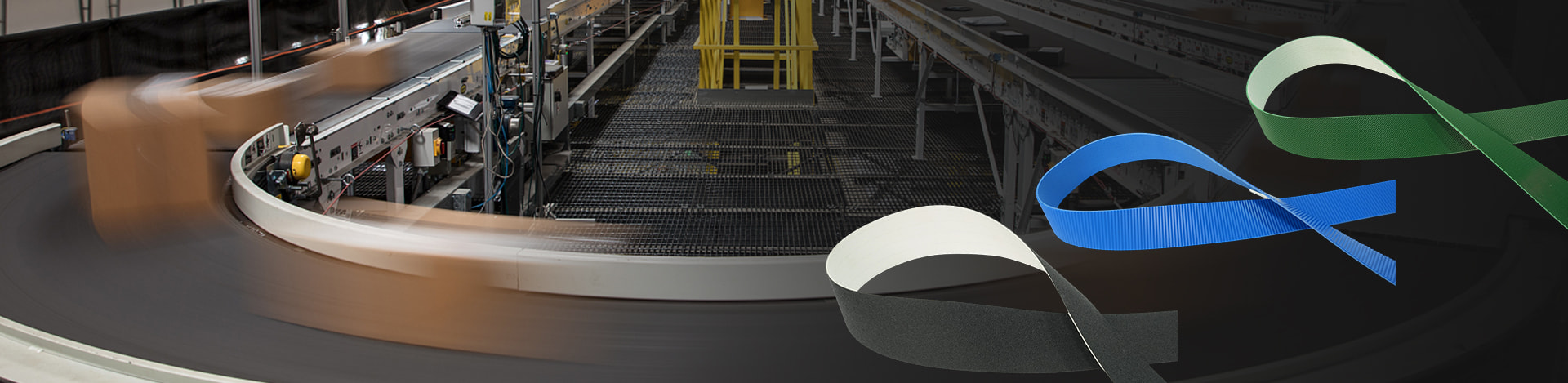
In the fields of industrial power transmission and precision conveying, customized timing belts represent high-precision drive components that transcend standard specifications. Based on rubber or polyurethane (PU) substrates, these belts undergo specialized secondary processing and composite modification to impart specific functional properties—such as wear resistance, cushioning, precise positioning, anti-slip capabilities, or non-stick characteristics. These highly tailored components are perfectly suited to the unique operational demands of complex automated conveyor lines, non-standard packaging machinery, and various high-precision industrial environments.
Core Modification Processes and Functional Classifications
Surface Composite Thickening Layers (Wear-resistant Red Rubber/Patterned Surfaces)
By thermally bonding or cold-adhering a layer of highly wear-resistant red rubber, PVC, or patterned PU to the belt's conveying surface, surface friction and tear resistance are significantly enhanced. Such designs are commonly employed in friction-based conveying systems—such as those used for carton transport or glass manufacturing—where strong grip and the prevention of material slippage are critical.
Cushioning and Flexible Protective Layers (Sponge/Novo)
A layer of sponge or specialized felt of a specific thickness is bonded to the back of the timing belt. The sponge layer utilizes its high elasticity and compressibility to provide gentle contact and shock absorption for fragile or delicate items (e.g., electronic components, eggs, thin-walled plastic parts). Meanwhile, the felt layer offers microporous breathability and heat resistance while preventing surface scratches on the conveyed materials.
Precision Positioning Mechanisms (Integrated/Welded Cleats)
Cleats of various shapes are vertically bonded or mechanically attached to the back of the timing belt at specific pitches, determined by material spacing requirements. This structure transforms the continuous conveying surface into discrete, metered transport units, enabling precise material pushing, vertical lifting and counting, and multi-axis synchronous alignment.
Surface Protection and Friction-Reducing Layers (Wear-resistant Fabric)
A layer of high-performance wear-resistant fabric (such as nylon) is bonded to the tooth side or the back of the timing belt. This fabric layer effectively reduces the coefficient of friction between the belt and guide rails—thereby lowering operating noise—while protecting the base belt from mechanical wear and direct chemical exposure, ultimately extending the service life of the core component.


 EN
EN
 English