en
 English
 русский
 Español
 عربى
All Kinds Of Pvc Conveyor Belt Types Provider
Home / Products / Flat Conveyor Belt / PVC Conveyor Belt

Home / Products / Flat Conveyor Belt / PVC Conveyor Belt
What a Flat Transmission Belt Does and When It Is the Right Choice A flat transmission belt is the best choice when you need smooth, quiet, high-speed power transfer between two shafts that are far apart, using plain pulleys without grooves. It works by friction between the belt surface and the pul...
READ MOREWhat a Flat Conveyor Belt Is and Where It Works Best A flat conveyor belt is a continuous loop of fabric-reinforced or solid material that carries products on a smooth, uninterrupted surface between two or more pulleys. It is the most common belt format for light and medium loads on packaging lines...
READ MOREQuick Answer: How to Choose Industrial Conveyor Belts The right industrial conveyor belts come from matching five factors: the material being carried, the load and belt speed, the operating temperature, the layout of the conveyor, and the cleaning or hygiene rules of the site. Rubber fabric belts ...
READ MORE
XINBEX BELTING (JIANGSU) CO., LTD. · SINCE 1998
We manufacture PVC Conveyor Belt Manufacturer lines for light-to-medium-duty conveying, with production bases in Xiamen and Nantong and an annual output of 2.5 million m². Our range covers glossy, patterned and double-sided polyester-fabric constructions for food processing, logistics, packaging and industrial automation.
Our PVC conveyor belt family is a composite construction: a functional Polyvinyl Chloride top surface bonded to a reinforcing fabric skeleton. That structure carries the tractive load while giving the contact face the properties the line needs — grip, release, cleaning or drainage.
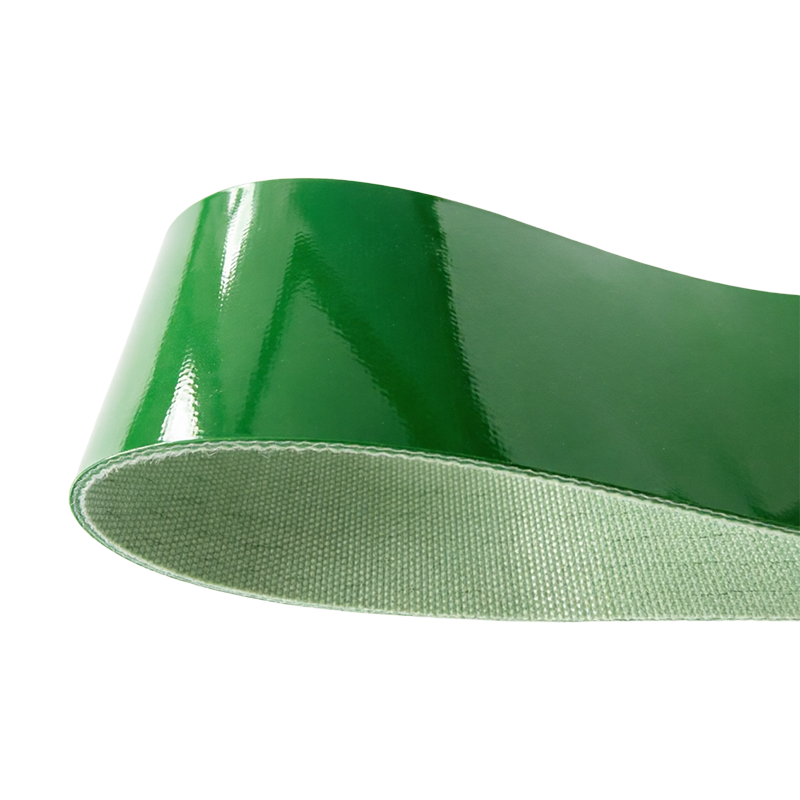
Smooth glossy surface for general flat conveying, assembly lines and light logistics where a clean, low-friction face is required.
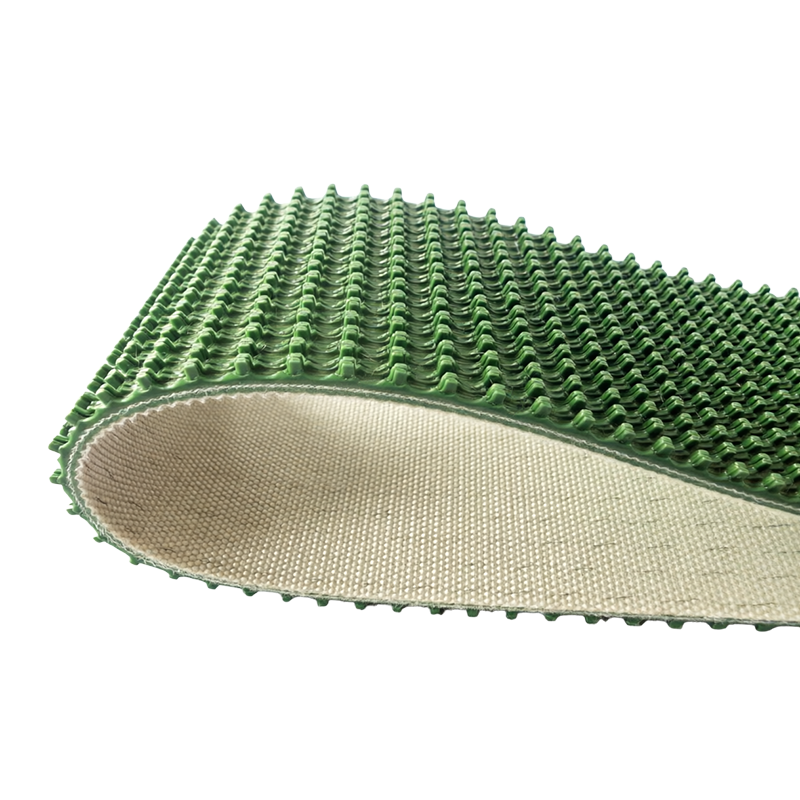
Patterned green surface that improves grip and release on inclines and in wet food environments; the textured profile aids drainage and product separation.
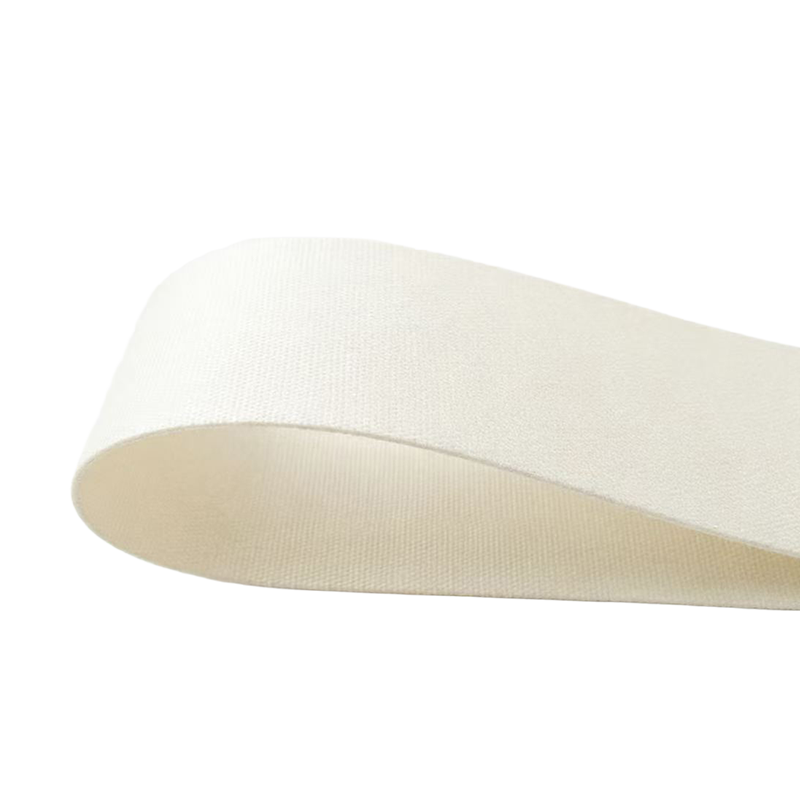
Polyester fabric on both faces for driven and idler pulleys where the belt runs over reverse bends or turns on rollers inside one loop.
PVC is a light-duty conveyor material with good dimensional stability and a surface that resists moisture, common cleaning agents and moderate chemical contact. It is widely used across food processing, logistics sorting, packaging and printing, woodworking, textile handling and battery/新能源 component lines.
Food & Bakery
Logistics & Sorting
Packaging & Printing
Automotive & Textile
Our belts are built from calendered or laminated PVC compound over one or more plies of polyester fabric. Surface finish, fabric plies and total thickness are set together during configuration because each changes the working tension, minimum pulley diameter and splice behavior.
| Parameter | What It Controls | Typical Selection Logic |
|---|---|---|
| Surface finish | Grip, release and cleanability | Glossy for flat products; pattern for incline or wet food |
| Fabric plies | Tensile capacity and elongation | More plies on long centre distances or high take-up |
| Total thickness | Cover wear life and pulley conformity | Balanced against minimum pulley diameter |
| Belt width | Load support and tracking margin | Set by product size plus edge clearance |
| Splice type | Joint strength and surface continuity | Hot-vulcanised or mechanical, per line access |
PVC belting takes secondary processing well, which is why the same base material can be adapted to many conveyor pvc layouts. We fabricate cleats, sidewalls, guide strips, perforations and edge sealing in-house during the finishing stage.
PVC belt is flexible and low in mass, so it responds quickly to start/stop signals and needs less inertial energy than heavier rubber constructions. For indexing and scanning stations this means shorter settle time; on curves and transfers it means the belt can follow small pulley diameters once the ply count is set correctly.
Our production runs through material preparation, belt forming, curing, surface processing, fabrication, splicing and final inspection. Each order follows the same QC route: dimensional check, splice integrity, surface inspection and, where the application calls for it, tensile or abrasion testing.
Where food contact is part of the process, we confirm the compound grade and documentation before the belt is built. Quality management is covered by ISO 9001, and our certificates include food contact safety and environmental qualifications.
Acceptance is agreed per order: dimensions, surface appearance, joint condition and any special testing identified in the proposal. The belt is identified and packed with its specification sheet to match the line record.
Belt installation is part of our field support. We can attend site for fitting, splicing, maintenance and belt optimisation, or supply the belt with installation guidance for the plant team to fit.
| Item | What We Provide | Maintenance Note |
|---|---|---|
| Belt specification | Grade, plies, finish and width | Keep on file for replacement orders |
| Splice data | Joint method and position | Inspect at first running-in period |
| Spare length | Cut-to-size standby belt | Reduces downtime on critical lines |
| Cleaning routine | Surface and joint care advice | Avoid sharp scrapers and harsh solvents |
PVC is one of four flat conveyor materials we manufacture, and each material suits a different operating condition. Where the line needs higher oil resistance or a softer food-contact surface, we can compare it with our PU Conveyor Belt Manufacturer range, where abrasion and chemical exposure are heavier, with our Rubber Conveyor Belt Manufacturer range, and where high temperature or release is critical, with silicone belting.
For a broader look across our flat belt programme, see the Flat Conveyor Belt Manufacturer range, where the material types are presented together for side-by-side selection.
We prepare a proposal from the line data you send us, not from a generic list. The more of the following we receive, the more precisely we can specify the belt and joint.
Working point
Product, unit weight, load per metre and conveyor speed
Geometry
Belt width, centre distance, incline and pulley diameters
Environment
Temperature range, moisture, cleaning chemistry and food contact
Processing needs
Cleats, sidewalls, guides, perforation and edge sealing
Joint access
Hopper, frame and access space for vulcanised or mechanical splice
Volume and delivery
Annual demand, first-order quantity and required delivery window
Are you a manufacturer of PVC conveyor belts?
Yes. XINBEX manufactures PVC, PU, rubber and silicone conveyor belts from two production bases in Xiamen and Nantong. Our PVC programme is part of the flat conveyor belt range and includes glossy, patterned and double-sided fabric constructions.
Which PVC conveyor belt types do you supply?
We supply the PB-G20 glossy green belt for general flat conveying, the PB-G50/D grass-pattern belt for grip and drainage on inclines and wet-food lines, and the TB-W18 double-sided polyester fabric belt for reverse-bend and roller return layouts. Each can be cut to width and fitted with cleats, guides or sidewalls.
Can PVC belt be spliced on site?
Yes. We supply belts with hot-vulcanised or mechanical splices and can attend site for installation and splicing. The splice method is chosen from the line's access, cleaning routine and required joint strength.
How do you handle food-contact PVC belt orders?
We confirm the compound grade and documentation for the application, build the belt to the agreed specification and include the specification sheet with the delivery. Quality management is covered by ISO 9001, and our certificates include food contact safety and environmental qualifications.
Can you supply custom widths, profiles and small batches?
We fabricate to drawing: width, length, cleat pattern, guide position, perforation and edge sealing are all set per order. Our two production bases support both large-volume and custom orders, so a special profile is not limited to a single large run.
What information do you need for a quotation?
Send the belt width, centre distance, product and load per metre, conveyor speed, pulley diameters, temperature and cleaning conditions, plus any cleat or guide drawing. That lets us confirm the ply count, finish, splice and quantity in the proposal.

+86-513-8633-0688
xinbex-js@xinbex.com
No. 152 Nanhai Road, Sanyu Town, Tongzhou District, Nantong City, Jiangsu Province, P.R.China
Copyright © XINBEX Belting (Jiangsu) Co., Ltd. Rights Reserved. OEM conveyor pvc manufacturers wholesale pvc conveyor belt suppliers